10 Pro Ways How to Use Sulfur Acidifier
Elemental sulfur hits alkaline soil like a controlled chemical burn, oxidizing into sulfuric acid over weeks as specialized bacteria feast on the powder. Most gardeners fail because they treat sulfur acidifier as a quick fix rather than a slow-release amendment that requires precise timing and microbial activity. Learning how to use sulfur acidifier correctly transforms unproductive high-pH ground into the acidic conditions that blueberries, azaleas, and rhododendrons demand for nutrient uptake.
Materials
Select elemental sulfur with 90% purity and a particle size between 100 and 200 mesh. Finer particles oxidize faster but can clump. Coarser granules take 18 months to achieve full acidification. Pair sulfur with an organic amendment rated 4-4-4 or 5-3-3 to feed the Thiobacillus bacteria responsible for conversion. Cottonseed meal at 6-2-1 provides both acidity and nitrogen while enhancing cation exchange capacity in clay soils.
Test soil pH with a calibrated meter, not paper strips. Target plants include blueberries (pH 4.5 to 5.5), camellias (pH 5.5 to 6.5), and pieris (pH 5.0 to 6.0). Calculate sulfur needs using this formula: pounds of sulfur per 100 square feet equals 2.0 times the pH reduction needed for loam, 2.5 for clay, and 1.5 for sand. A drop from pH 7.5 to 5.5 in loam requires 4 pounds of elemental sulfur per 100 square feet.
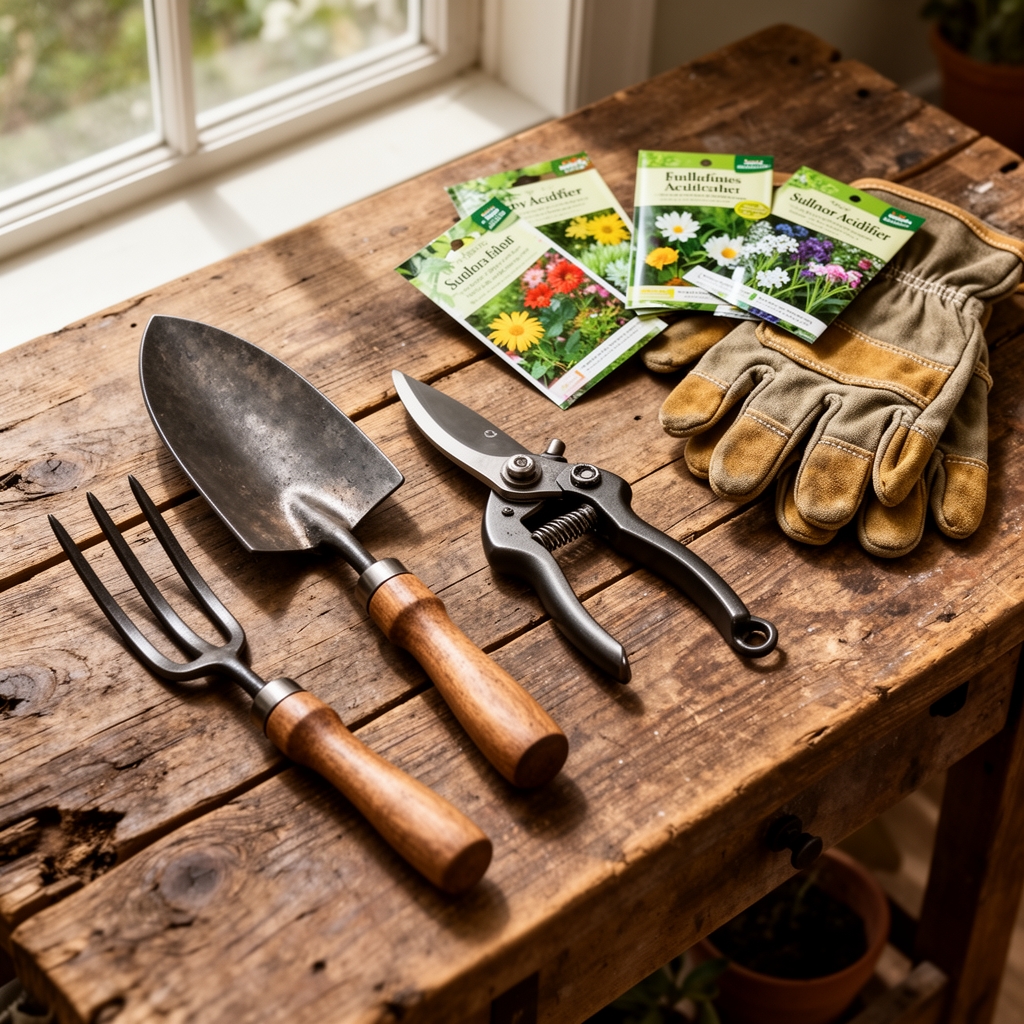
Gather a broadcast spreader for even distribution, a rotary tiller for incorporation to 6 inches, and a soil moisture meter to maintain 60% field capacity during oxidation. Stock sulfur-coated urea (SCU) with a 38-0-0 ratio for sustained nitrogen release in established beds where additional pH drop is minimal.
Timing
Apply sulfur acidifier during fall dormancy in Zones 5 through 7, allowing 4 to 6 months for bacterial oxidation before spring planting. Thiobacillus denitrificans and T. thiooxidans require soil temperatures above 55°F and consistent moisture. In Zones 8 and 9, apply sulfur 90 days before the last average frost date to synchronize acidification with root flush.
Avoid application within 30 days of lime, wood ash, or high-calcium fertilizers. Calcium carbonate neutralizes sulfuric acid instantly, wasting material and money. Split heavy applications across two seasons if pH reduction exceeds 1.5 units. A single massive dose can create localized acid pockets below pH 4.0, killing beneficial mycorrhizal fungi and earthworms.
Phases

Initial Amendment: Broadcast sulfur evenly across the planting area at the calculated rate. Till to a depth of 6 inches, mixing sulfur into the root zone where oxidation occurs. Water immediately to 1 inch of penetration, initiating bacterial colonization. Retest pH at 60 and 120 days post-application using samples from 4 to 6 inches deep.
Pro-Tip: Inoculate soil with ericoid mycorrhizae at this stage. These fungi extend root surface area by 700% and enhance iron uptake in acidic conditions.
Transplanting: Set bare-root or containerized acid-loving plants when soil pH stabilizes within the target range. Dig holes twice the root ball width and equal depth. Backfill with native soil amended with 20% aged pine bark (pH 4.0 to 4.5) to buffer against alkaline water. Position the crown 1 inch above grade to prevent stem rot in saturated acidic soil.
Apply 2 inches of pine needle mulch in a 36-inch diameter ring, keeping material 3 inches from the stem. Pine straw decomposes into additional organic acids, sustaining pH over 3 to 5 years. Water transplants with rainwater or reverse osmosis water to avoid reintroducing carbonates.
Pro-Tip: Prune blueberry whips at a 45-degree angle, removing 40% of top growth to redirect auxin distribution into root establishment during the first season.
Establishment: Monitor soil pH quarterly for the first two years using a slurry test. Mix 1 part soil to 1 part distilled water, let settle for 30 minutes, and measure the supernatant. If pH creeps above 6.0, apply maintenance sulfur at 25% of the initial rate. Incorporate sulfur into the top 2 inches only to avoid root disturbance.
Pro-Tip: Foliar-feed iron chelate (Fe-EDDHA) at 0.5 ounces per gallon if interveinal chlorosis appears despite correct soil pH. Alkaline microsites can persist in clay lenses.
Troubleshooting
Symptom: Yellowing leaves with green veins (chlorosis).
Solution: Measure soil pH immediately. If above 6.5, apply additional sulfur and drench with aluminum sulfate solution (1 tablespoon per gallon) for rapid correction within 10 days. Aluminum sulfate drops pH instantly but does not persist like elemental sulfur.
Symptom: Stunted growth and purple-tinged foliage.
Solution: Indicates phosphorus lockout from excessively low pH below 4.0. Broadcast dolomitic lime at 5 pounds per 100 square feet and water deeply. Retest in 14 days and adjust toward pH 5.0.
Symptom: White fungal threads on mulch surface.
Solution: Saprophytic fungi processing organic matter, not pathogenic. Rake mulch lightly to increase air circulation. Excessive sulfur can suppress beneficial fungi; reduce rates by 15% in future applications.
Symptom: Leaf scorch on margins.
Solution: Salt burn from over-application of aluminum sulfate or ammonium sulfate. Leach soil with 2 inches of water per week for three weeks. Switch to elemental sulfur for long-term management.
Maintenance
Acid-loving plants in amended soil require 1 inch of water per week during active growth, delivered in two 0.5-inch sessions. Install a rain gauge and subtract natural precipitation. Apply 3-4-4 organic fertilizer at 2 pounds per 100 square feet in early spring, avoiding high-phosphorus blends that reduce mycorrhizal colonization.
Reapply maintenance sulfur every 24 months at 1 to 1.5 pounds per 100 square feet, adjusting based on pH testing. Irrigate with acidified water (pH 5.5) if municipal sources exceed pH 7.5. Add citric acid at 1 teaspoon per 2 gallons to neutralize carbonates without introducing sodium.
Renew pine needle mulch annually to maintain a 3-inch layer. Prune dead wood in late winter before bud break, cutting 0.25 inches above outward-facing buds to encourage horizontal branching and light penetration.
FAQ
How long does sulfur take to lower pH?
Elemental sulfur requires 8 to 16 weeks for measurable pH reduction, depending on particle size, soil temperature, and moisture. Bacterial populations peak at 65°F to 85°F.
Can I use sulfur on established plants?
Yes. Apply at half the initial rate in a 12-inch band around the drip line. Water thoroughly and avoid root zone disruption within 6 inches of the crown.
What is the difference between elemental sulfur and sulfate forms?
Elemental sulfur oxidizes slowly via bacteria. Aluminum sulfate and ammonium sulfate act immediately but leach quickly and can cause salt damage at high rates.
Will sulfur harm beneficial insects?
No. Sulfur targets soil chemistry, not arthropods. Avoid dusting foliage with sulfur fungicides during bloom to protect pollinators.
How do I prevent pH rebound?
Use low-alkalinity water, maintain organic mulch, and retest soil every 6 months. Clay soils with high cation exchange capacity resist rebound better than sand.